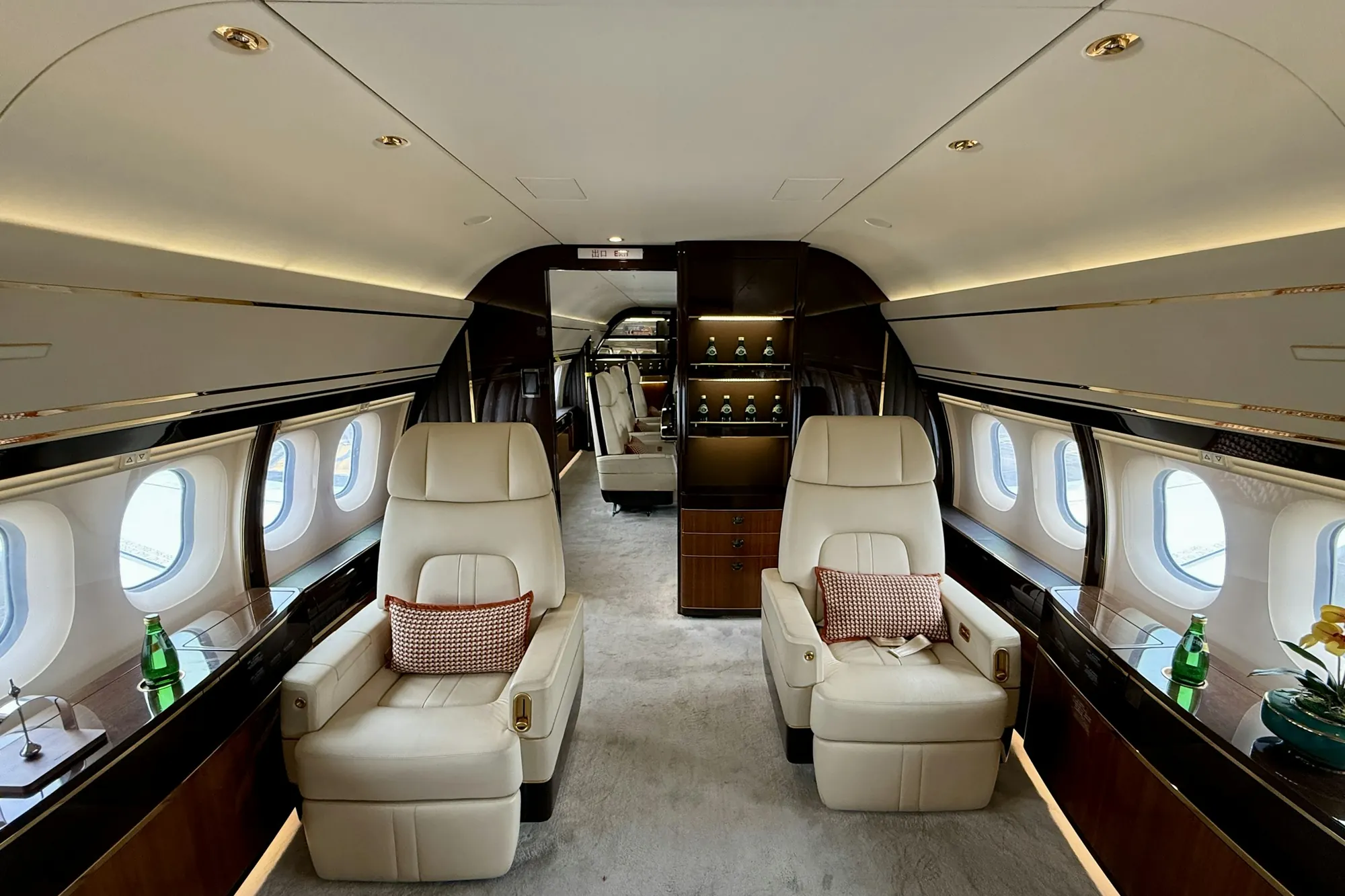
Hourly rates are the shorthand of private aviation. They are useful for comparing aircraft classes and for a first sense of budget, and they are also easy to misread. This article sets out typical US charter rates for each category and then the caveats: what pushes a quote to the top or bottom of a range, and what the hourly figure leaves out altogether.
The ranges
| Category | Typical aircraft | Seats | Per hour |
|---|---|---|---|
| Turboprop | PC-12, King Air 350 | 6–9 | $1,800–3,200 |
| Very light jet | HondaJet, Citation M2 | 4–5 | $2,800–4,200 |
| Light jet | Phenom 300E, Citation CJ4, Learjet 75 | 6–8 | $3,500–5,500 |
| Midsize | Citation XLS+ | 7–9 | $4,500–7,000 |
| Super-midsize | Challenger 350, Citation Longitude, Praetor 600 | 8–10 | $6,500–9,500 |
| Large cabin | G450, Challenger 650, Falcon 2000LXS | 10–16 | $8,500–13,000 |
| Ultra long range | G650ER, Global 7500 | 13–19 | $12,000–20,000+ |
Each range is wide for a reason: it covers different aircraft models, ages and operators across the country, at different times of year. The useful question is not what the average is, but what decides where your trip will land.
Caveat 1: the rate is for flying hours only
An hourly rate multiplies billed hours, and billed hours are rarely the same as the flight time on the schedule. Taxi time may be included, either as block time or as a fixed allowance. Daily minimums, often one to two hours a day, apply to short flights and to days the aircraft spends waiting for you. Repositioning, the empty flying needed to bring the aircraft to you or take it home, is billed at the same rate. Our article on block time and flight time goes into the first of these in detail.
Caveat 2: tax and fees sit on top
Domestic US charter carries the 7.5% federal excise tax on the cost of transportation and a segment fee of about $5 per passenger per leg, indexed each year. International trips carry their own taxes and fees instead. Landing and handling charges, crew overnight costs, catering, Wi-Fi and winter de-icing are added where they apply. None of these are in the hourly figure.
Caveat 3: what moves a rate inside its range
- Aircraft age and interior. A newer airframe or a recent refurbishment sits higher in the range.
- Where the aircraft is based. An aircraft already at your departure airport avoids repositioning, and operators in some regions price higher than others.
- Dates. Holiday weekends and major events push demand and prices up; quieter midweek days often do the opposite.
- Trip shape. A one-way trip that leaves the aircraft far from home usually carries the cost of getting it back.
- Destination. Mountain airports, slot-controlled fields and international arrivals can add planning, fees or crew costs.
Caveat 4: cheaper per hour is not always cheaper per trip
A bigger aircraft costs more per hour but can fly further without stopping. On a long trip, a light jet that needs a fuel stop pays for extra climb and descent, landing fees and time on the ground, and the trip takes longer. A super-midsize flying the same route nonstop can end up close on total cost. On short routes the opposite holds: a turboprop is slower, but over 45 minutes the difference is a few minutes and the hourly saving is large.
The same principle works across a single route. For Teterboro to Palm Beach, about two and a half hours in a jet, flight-time costs before tax and fees look roughly like this:
| Category | Approx. flight time | Flight-time cost |
|---|---|---|
| Turboprop | about 3 h 15 | $5,850–10,400 |
| Light jet | 2 h 30 | $8,750–13,750 |
| Midsize | 2 h 30 | $11,250–17,500 |
| Super-midsize | 2 h 30 | $16,250–23,750 |
| Large cabin | 2 h 30 | $21,250–32,500 |
For six people, the light jet is the natural choice. For twelve, a large cabin replaces two light jets and the per-seat numbers converge. The hourly rate alone would not tell you either of those things.
Caveat 5: memberships price hours differently
Jet cards and similar programmes sell prepaid hours at a fixed rate. That fixed rate often comes with peak-day surcharges, daily minimums of their own and rules on how time is counted. It can suit frequent flyers who value predictability. For a one-off trip, on-demand charter priced for the actual itinerary is usually the clearer comparison, and it needs no membership or deposit.
Caveat 6: international trips price differently
The ranges here describe US charter. A trip that starts or ends abroad replaces the domestic excise tax with international taxes and fees, may need an operator with specific approvals for the destination, and can involve longer crew duty days with overnight stops. Aircraft based outside the US are often priced in other currencies and to different conventions. The hourly figure is still a useful guide to the category, but the gap between the rate and the final price tends to be wider.
Using the ranges well
Treat the ranges as a map, not a price list. Use them to decide which one or two categories fit your group and distance, then get the trip quoted on specific aircraft. Our quotes show the billed hours and every tax and fee inside one all-in total, so the comparison between options is like for like. To see how billed hours build up for a given flight time, try the hours estimator.